From Ankara to the Adriatic
In September 2026 I joined the Abdus Salam International Centre for Theoretical Physics in Trieste as a student in its Postgraduate Diploma Programme, an intensive one-year pre-PhD programme. I am part of the High Energy, Cosmology and Astroparticle Physics (HECAP) section, and my own scientific centre of gravity is inflation: the attempt to use the first instants of cosmic history to learn about fields, gravity, symmetries and energy scales far beyond direct terrestrial reach.
This is more than a change of affiliation for me. It is a chance to bring the research questions I developed during my undergraduate years into an environment built around high-energy theory, cosmology and international scientific exchange. I want the Diploma year to sharpen both sides of my work: the formal foundations—quantum field theory, gravitation and particle physics—and the phenomenological question of what the sky can actually tell us about the early Universe.

HECAP · ICTP
High Energy, Cosmology and Astroparticle Physics
The Abdus Salam International Centre for Theoretical Physics
Trieste, Italy
Training → research → dissertation
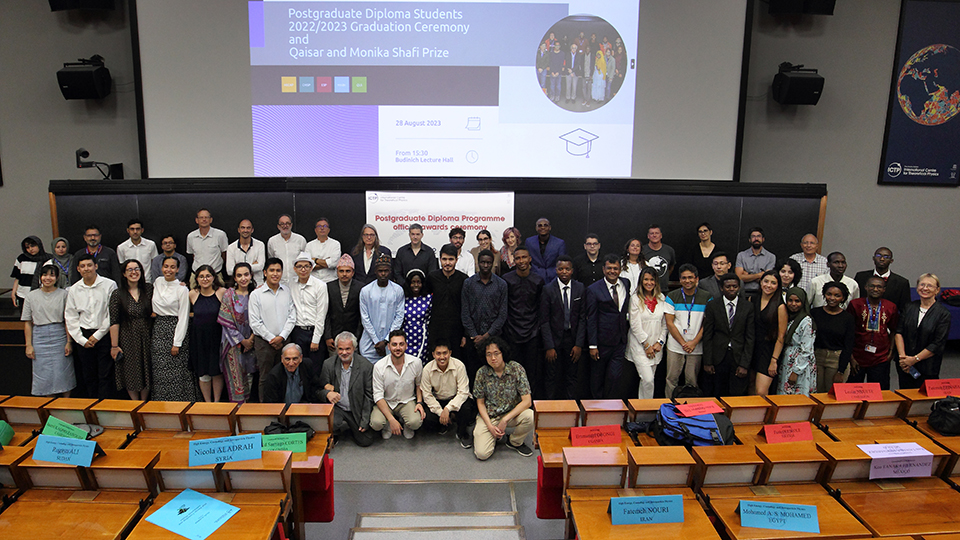
The ICTP Postgraduate Diploma is designed as preparation for PhD study. The programme combines advanced courses and examinations with a research project and dissertation. Within HECAP, that means working from the language of quantum mechanics, field theory, general relativity and the Standard Model toward the frontier problems where those subjects meet cosmology.
Foundations
Strengthening the high-energy theory toolkit: quantum mechanics, quantum field theory, general relativity, particle physics and the mathematical structures behind them.
Research focus
Narrowing those tools onto inflation and early-universe physics: model building, perturbations, gravitational frameworks, particle-cosmology connections and observational signatures.
Dissertation
Developing a focused research project into a coherent piece of work, with the aim of entering PhD research with stronger theoretical depth and a clearer scientific programme.
Inflation as a laboratory for fundamental physics
ICTP’s HECAP cosmology programme includes inflation, gravitational waves, black holes and the physics of the evolving Universe. My own work sits most directly in inflation and its interfaces. I am interested not in treating inflation as a single isolated model, but as a meeting point between high-energy theory and cosmological data.
Inflation & gravity
How metric, Palatini and more general gravitational frameworks reshape the inflationary background, perturbations and observable predictions.
Inflation & particle physics
Connecting the inflaton sector to high-energy structure, including GUT-motivated models, reheating, leptogenesis and dark-sector production.
Multifield dynamics
Field-space geometry, entropy modes, turns in field space, non-Gaussianity and the richer dynamics that appear beyond the single-field approximation.
Observable relics
Primordial gravitational waves, parity-sensitive signatures, primordial black holes and other possible ways of turning early-universe theory into empirical tests.
HECAP and the Trieste theory community
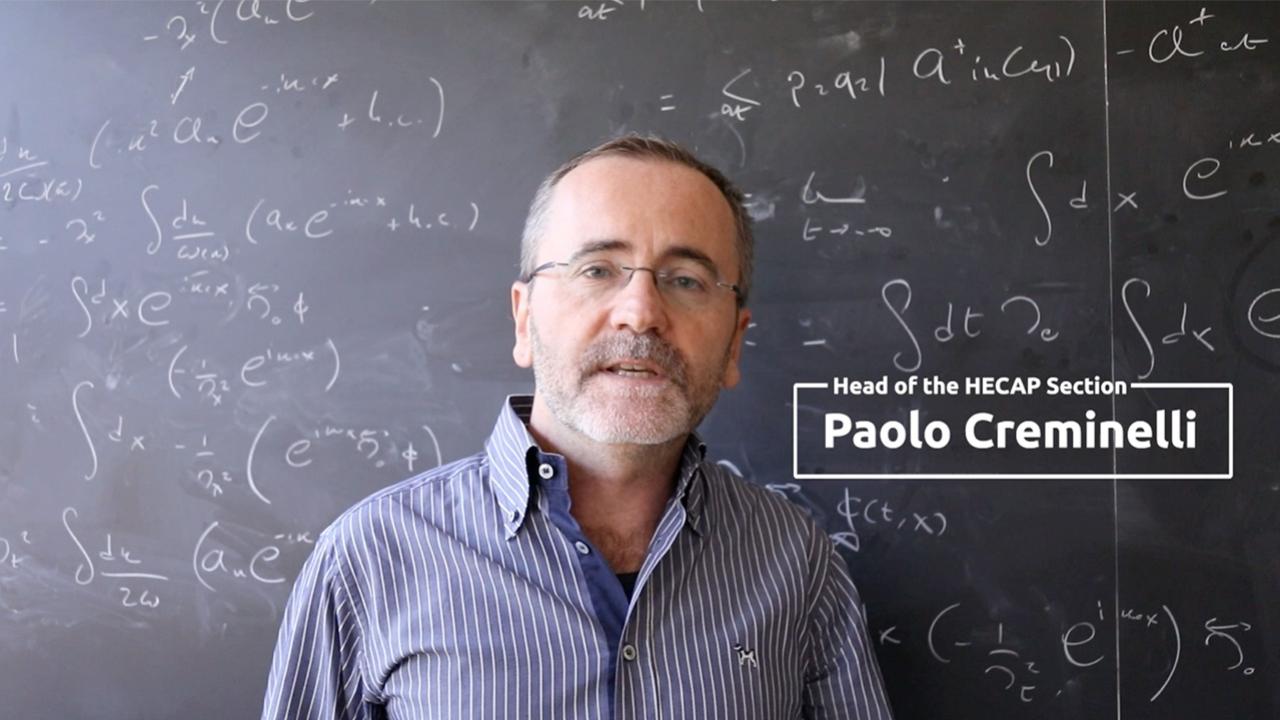
HECAP studies problems ranging from string theory and quantum gravity to particle phenomenology, cosmology and experimental particle physics. ICTP also works closely with SISSA, the University of Trieste and INFN, placing the Centre inside one of Europe’s unusually dense concentrations of theoretical-physics activity. For an early-career cosmologist, that means seminars, visitors, workshops and conversations that continuously cross the boundaries between subfields.
Abdus Salam and the idea behind ICTP
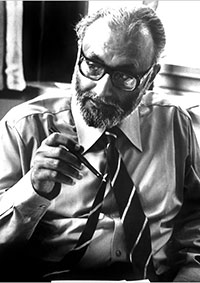
ICTP was founded in 1964 by Nobel Laureate Abdus Salam together with Paolo Budinich. Salam’s vision joined frontier theoretical physics with a conviction that geographic circumstance should not determine who gets to participate in science. In 2026, the Centre is also marking the centennial of Salam’s birth.
That history matters to me. Coming to ICTP after my undergraduate years in Türkiye, I see the Centre not only as a place to prepare for a PhD, but as part of a larger scientific tradition: serious fundamental physics made more international, more connected, and more open to people whose routes into research are not always straightforward.
Read more from ICTP
Institutional descriptions and programme structure on this page are based on ICTP’s official HECAP, research-area and Postgraduate Diploma pages. ICTP photographs and logo are loaded from ICTP’s official web assets; they remain the property of their respective rights holders.